
You’ve seen your kid struggling and decided it’s time to invest in child therapy services. But then you start to hear from other parents and therapists what some of these sessions can look like: playing games, using toys, engaging in make believe and more. That all sounds fun, but is it really helping your child develop the skills you brought them to a pediatric therapy clinic for?
The truth is that play-based therapy can be very effective since it engages children in things they enjoy. However, this is only when the play-based therapy is done correctly by certified pediatric therapists. Here’s how you can make sure the child therapy services your child is receiving are actually benefitting them:
- Understand why therapy looks like play
- Determine what kind of therapy your child needs
- Verify a provider’s credentials
- Ask questions at your child’s evaluation
- Know what success signs to look for
As the winner of 2025’s Best of Tennessee child therapy services category, The TEACH Group helps children build important skills through play and keeps parents involved so you know progress is being made. Let’s break down exactly how you can tell if pediatric therapy is actually helping your child.
Looking for ways to help your child develop important skills at home? Check out our guide, 10 Activities to Improve Your Child’s Executive Functioning
Understand Why Therapy Looks Like Play
Here’s the truth: kids don’t learn and grow when they’re bored. That’s why child therapy services must include play. However, this doesn’t mean your child’s sessions should focus on fun first and growth second. In quality pediatric therapy, every activity is chosen for a reason, tied to a specific goal, and tracked over time to ensure your child is making progress.
A pediatric therapist might use blocks, bubbles, a pretend kitchen set, or something else entirely to engage your child, but they don’t stop there. Pediatric therapists design play-based therapy with the following questions in mind:
- Is this activity connected to a written goal for this specific child?
- Can the therapist explain what skill it’s building and why?
- Is progress being measured, not just observed?
- Is the skill expected to carry over into home, school, and everyday life?
Don’t be afraid to ask pediatric therapy clinics in Knoxville these questions. If the answer to these questions is yes, you’re likely looking at an experienced team who is determined to actually help your child.
Determine What Kind of Therapy Your Child Needs
It can feel overwhelming to see your child struggling and not know how to help them. You think they need some kind of pediatric therapy but have no idea where to start. Expert pediatric therapy Knoxville clinics don’t need you to know. They will help find the right solution for your child through a formal evaluation. Here are some of the most common types of child therapy services:
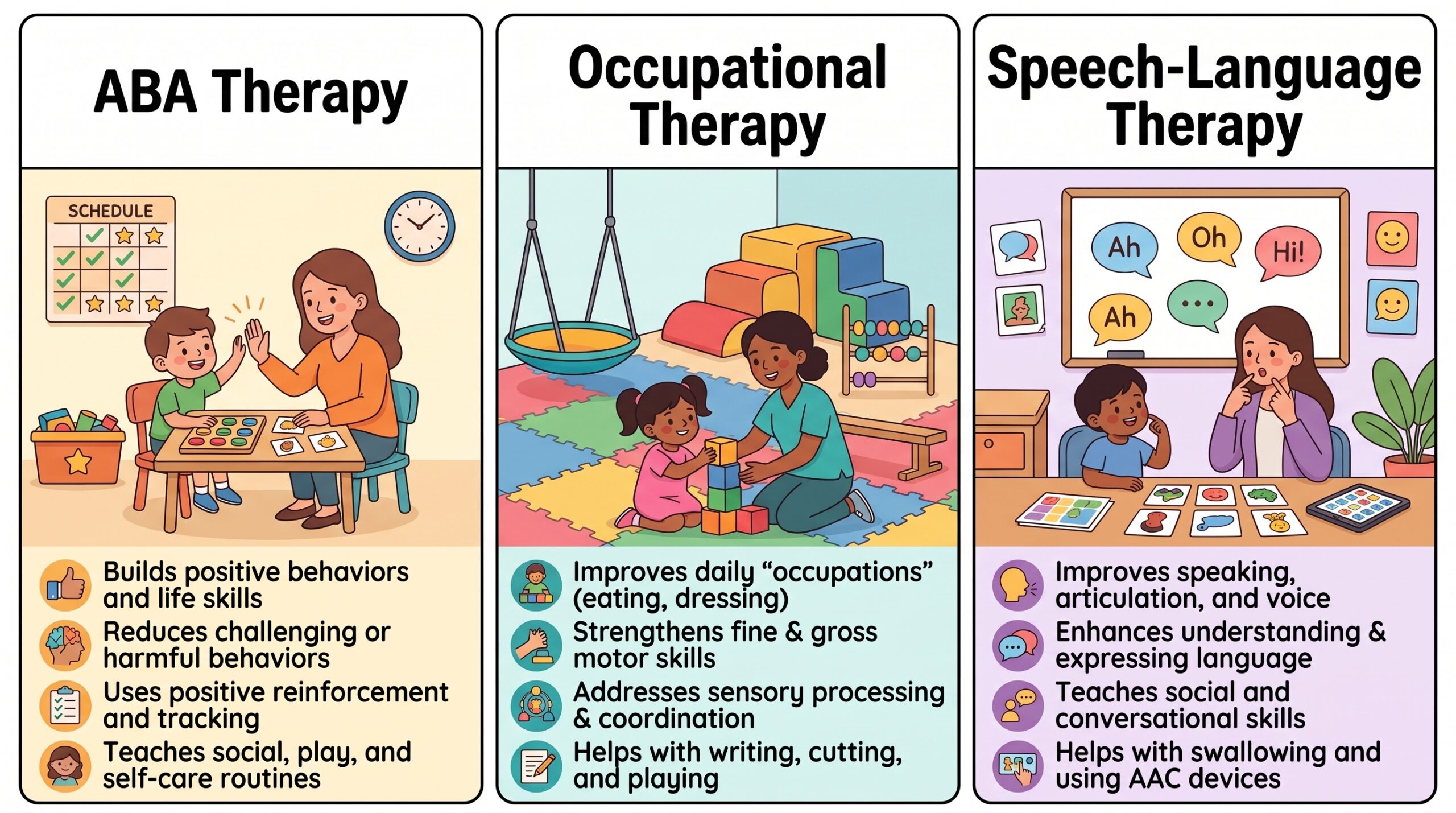
ABA Therapy
Applied behavior analysis (ABA) therapy focuses on developing communication, behavior, and social skills. Sessions at ABA therapy Knoxville clinics are designed by a Board-Certified Behavior Analyst (BCBA) and often carried out day-to-day by a Registered Behavior Technician (RBT) under the BCBA’s supervision. Play is used here to teach and reinforce specific skills like asking for something, taking turns, or following simple directions. Progress is tracked with structured data, following the child as they learn to use these skills in sessions and everyday life.
Occupational Therapy
Occupational therapy targets fine motor skills, sensory processing, and daily living skills like getting dressed. This therapy is delivered by a licensed occupational therapist. And because play is such a big part of childhood, occupational therapy Knoxville clinics often look like playrooms, full of obstacle courses, swings, or bins of textured toys. These elements are used deliberately by trained OTs to build core strength, motor planning, and sensory regulation to meet a specific, written goal.
Speech-Language Therapy
Speech-language therapy helps children learn articulation, vocabulary, sentence structure, and social communication. It’s delivered by a speech-language pathologist and involves so much more than just showing children how to communicate. For example, a speech-language pathologist might play a game of pretend kitchen with a child to promote building specific sounds, new vocabulary, or turn-taking in conversation. These kinds of play-based activities teach children how to communicate in simulated situations that can easily be applied to real life.
These different kinds of therapy may have different goals, experts, and day-to-day activities, but they all share the same underlying standard: purposeful, individual, and measured therapy. This standard is what separates real therapy from a well-meaning but generic play-based program.
Verify a Provider’s Credentials
When considering child therapy services, you want to make sure your kid gets the best care possible. This means seeing a licensed pediatric therapist who has experience working with similar cases. Always ask to see a pediatric therapist’s credentials. For extra measures, you can look up a pediatric therapist’s credentials online using the following sites:
- BACB Certificant Registry confirms a Board-Certified Behavior Analyst’s certification is active. Necessary for ABA therapy.
- Verification of ASHA Certification confirms a speech-language pathologist holds an active CCC-SLP or Certificate of Clinical Competence in Speech-Language Pathology.
- Tennessee Department of Health: Licensure Verification confirms an occupational therapist’s Tennessee state license is active and in good standing. Also allows for other health related license verifications.
It only takes a few minutes to look up your provider on one of these sites, and a reliable pediatric therapist will have no problem with you checking their licenses. However, every pediatric therapist is different, even when they hold the same certifications. That’s why you need to be prepared to meet with potential pediatric therapists and get a feel for how they operate before signing your child up for regular appointments.
Ask Questions at Your Child’s Evaluation
Once you’ve found a licensed pediatric therapist that specializes in what your child needs, it’s time to see if their team is a good fit for your family. This starts with scheduling an evaluation where a pediatric therapist will meet with you and your child to hear your concerns and gather developmental history. They will also ask questions about your child’s specific strengths, challenges, and needs so they can create a customized therapy plan for your little one.
Your child’s pediatric therapy evaluation isn’t just for the therapist to get to know your child, it’s also for you to get to know the therapist and determine if they are a good fit for your family. Bring the following questions to your child’s first evaluation:
- How was this treatment plan developed, and how is it specific to my child?
- What credentials do the therapists working directly with my child hold?
- How often will a supervising clinician (like a BCBA or licensed therapist) review or observe sessions?
- How will you track and share my child’s progress with me?
- How often are goals reassessed and updated?
- How do you help skills carry over to home and school?
- How will I be involved in the process?
Getting the answers to these questions reveals just how thorough a pediatric therapy Knoxville clinic is. You want a team that won’t just play with your child but help them develop and keep you in the loop.
Know What Success Signs to Look For
Seeing how much fun your child is having at therapy is important, but it isn’t the main goal. You need to know that your child is developing the skills you brought them in for in the first place. Whether you’re working with an ABA, speech, or occupational therapy Knoxville clinic, the same signs of progress apply, such as:
- Staff can explain why your child is doing a certain activity and what skill it’s building.
- You see growth through session notes, progress summaries, and updated goals.
- Skills your child is developing in therapy show up at home, school, and everywhere else.
But what exactly does this look like? Let’s take a look at one of our patient stories and see how Timothy saw his child develop the skills his pediatric therapists were working on:
“As a parent of a child with ASD and developmental delays, finding the right support for my son was paramount. The TEACH Group has been an invaluable part of our journey. For the past nine months, my son has been attending speech, ABA, and OT therapy sessions with their team, and the progress he has made is nothing short of remarkable and transformative.
The team at The TEACH Group goes above and beyond in every aspect of care. Not only do they provide exceptional therapy, but they also take the time to ensure that I am fully informed and educated about the process. They meticulously explain the goals they are working on, allowing me to reinforce these lessons at home. This collaborative approach has been instrumental in my son’s development.” – Timothy
Progress can take time, but a pediatric therapist can see the signs that skills are starting to develop and share these wins with you. This ensures you know every time your child makes progress, even if the changes aren’t drastic yet. One day they will be and your kid will have all the skills they need to thrive.
See Results from Your Child’s Therapy Services with The TEACH Group
You always want what’s best for your child, and it can be difficult to know if child therapy services are actually helping your kid if you don’t know what to look for. At The TEACH Group, we make sure every parent is kept in the loop so they know exactly how much their child is growing. Schedule an evaluation today to get your child started on their journey to developing crucial life skills.
Child Therapy Services FAQs
Look for a written, individualized treatment plan, regular data tracking on specific goals, a supervising BCBA who’s actively involved (not just a name on paperwork), and skills that show up at home and school, not just in the clinic.
It can look like play, but real OT ties every activity to a specific, measurable goal — like improving fine motor control, sensory regulation, or self-care skills — set by a licensed occupational therapist based on a formal assessment.
A thorough assessment of your child’s specific strengths and needs, a clear explanation of recommended services, and an individualized plan — not a one-size-fits-all program applied to every child.
Yes. Play is a natural and effective way for children to learn, and therapists across ABA, OT, and speech therapy intentionally use it. The key difference is whether that play is tied to specific goals and tracked over time.
Goals should be reviewed and adjusted regularly as your child progresses — typically every few months. If goals haven’t changed in a long time despite your child growing and changing, it’s worth asking why.
Look for measurable data or progress notes shared with you regularly, and skills that generalize beyond the therapy room into home, school, and daily routines — not just improvement you’re told about anecdotally.
Watch for generic, one-size-fits-all activities regardless of a child’s individual goals, no data or progress updates, high staff turnover, vague answers about staff credentials, and goals that never change.
Parents should be actively included — understanding session goals, receiving strategies to reinforce skills at home, and getting regular updates on progress, rather than being kept at arm’s length from the process.
Ask how treatment plans are developed, what credentials the therapists hold, how often a supervising clinician reviews progress, how progress is measured and shared, and how skills are expected to carry over to home and school.
Enjoy content from The TEACH Group? Make us one of your preferred sources on Google.